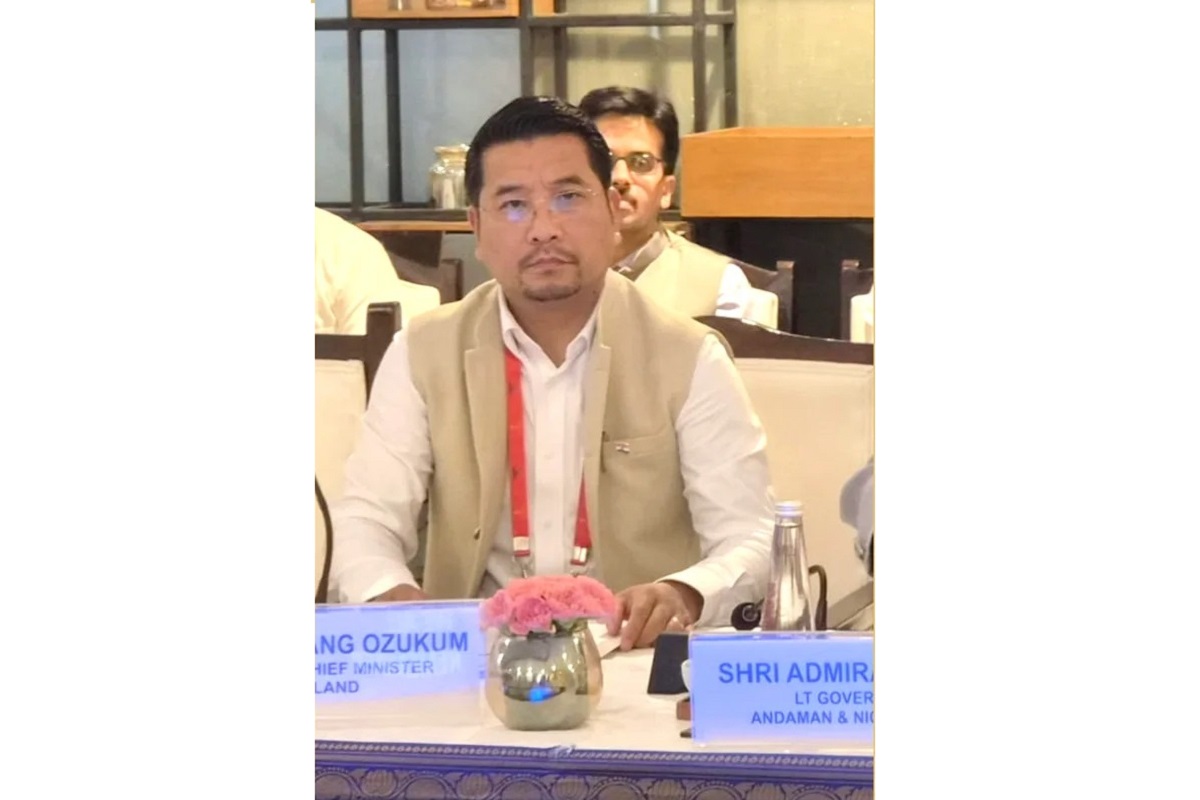
Nagaland Advisor for Water Resources Tongpang Ozukum has urged the Ministry of Jal Shakti to ensure the timely release of funds for water infrastructure projects in the state, pointing to Nagaland’s short working season and the challenges of completing projects within the stipulated time.
Ozukum raised the issues at the Jal Shakti Departmental Summit, held at Sushma Swaraj Bhawan in New Delhi on September 1 and 2.
He said Nagaland implements only Minor Irrigation projects and therefore faces comparatively fewer difficulties related to land acquisition, contractual and project management issues, design modifications, and inter-state or inter-agency coordination. However, he identified the timely release of funds as a major concern for the state.
According to Ozukum, Nagaland’s effective working season is limited to around six months, from November to April. He stressed that funds need to be released on time so that projects can be taken up and completed during the available working period.
The advisor also proposed changes to certain financial and administrative requirements. He suggested that the audit certificate currently required every nine months should instead be permitted once every two years, saying the existing frequency creates difficulties for the department.
Regarding the SNA-SPARSH module, which provides real-time monitoring of fund releases and expenditure and is intended to improve financial transparency and accountability, Ozukum requested that mother sanctions be released in a maximum of two instalments each year.
He also proposed that Surface Minor Irrigation projects approved by the State Level Sanctioning Committee should not have to undergo re-approval in subsequent years.
Ozukum further called for provisions to account for price escalation in projects that face delays at the commencement stage and subsequently incur cost overruns. He said such a provision would help prevent changes in project scope and ensure that the quality of works is maintained.
He also proposed raising the development cost ceiling for Minor Irrigation projects from Rs 4 lakh to Rs 6.5 lakh per hectare, citing the need to address implementation-related challenges.
On flood management, Ozukum said Nagaland had not received a single project under the Flood Management and Border Areas Programme (FMBAP) for more than a decade, despite the state having submitted four proposals.
He urged the Ministry of Jal Shakti to sanction at least one FMBAP project for Nagaland during the current financial year.
The advisor also highlighted erosion problems affecting areas along the Chathe River in Chümoukedima, Tuli town in Mokokchung and Naginimora in Mon district. He urged the ministry to permit both conventional and non-conventional methods for anti-erosion works, depending on the requirements of individual locations.
At the summit, Ozukum also highlighted the Nagaland Strategic Water Resilience Initiative for 2026-27, aimed at strengthening water security in the state.
He said Nagaland receives heavy rainfall during the monsoon but experiences acute water shortages during the lean season because of its hilly terrain and high surface runoff. The state therefore needs measures to capture and store water during the rainy months for use during periods of scarcity.
As part of this approach, Ozukum said the state has adopted farm ponds as micro water-harvesting structures under the NABARD Rural Infrastructure Development Fund. He said the initiative would support rural livelihoods and local ecosystems while promoting water conservation, water storage, groundwater recharge and better water management.