
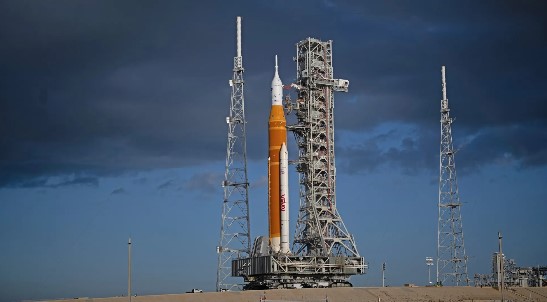
In a momentous step forward for deep-space exploration, the massive core stage of NASA’s Artemis II rocket arrived at Launch Pad 39B at the Kennedy Space Center on Saturday, March 21, 2026, marking a critical transition from assembly to active launch preparations. The arrival of the 212-foot-tall orange core stage, which serves as the backbone of the Space Launch System (SLS), signifies the start of a rigorous testing phase designed to ensure the vehicle is ready to carry humans around the Moon for the first time in over five decades. This specific mission is the first crewed flight under the Artemis program, carrying a diverse crew of four—Commander Reid Wiseman, Pilot Victor Glover, and Mission Specialists Christina Koch and Jeremy Hansen—on a high-stakes journey that will pave the way for a future lunar landing. The rollout to the pad was a meticulously orchestrated event, with the rocket being transported via the iconic crawler-transporter, moving at a speed of less than 1 mph to ensure the structural integrity of the hardware remained intact during the four-mile journey from the Vehicle Assembly Building.
Once secured at Pad 39B, the SLS rocket will undergo a series of “wet dress rehearsals,” where the launch teams will practice the complex fueling procedures and countdown sequences required for a successful liftoff. These tests are essential for validating the improvements made to the ground systems following the Artemis I uncrewed mission, specifically addressing the cryogenic fuel loading challenges that were encountered during previous campaigns. Engineers will also be monitoring the integration of the Orion spacecraft atop the rocket, ensuring that all communication and life-support interfaces are fully synchronized before the crew arrives for final training. NASA officials have noted that the arrival at the pad is a “psychological and technical win” for the agency, as it visually demonstrates the progress made toward returning human presence to the lunar vicinity. The launch pad itself has undergone significant upgrades to support the increased weight and power of the SLS, including a redesigned flame deflector and enhanced sound suppression systems to protect the vehicle during ignition.
The significance of Artemis II cannot be overstated, as it serves as the ultimate proving ground for the systems that will eventually sustain long-duration missions to Mars. By sending a crew 2,300 miles past the far side of the Moon, NASA aims to test the Orion spacecraft’s heat shield and radiation protection in a true deep-space environment. As the rocket stands tall against the Florida coastline, it serves as a beacon of international collaboration and technical prowess, involving contributions from the European Space Agency and the Canadian Space Agency. While the exact launch date remains subject to the results of these upcoming pad tests, the goal remains a late 2026 liftoff. For now, the global scientific community and space enthusiasts alike are focused on Pad 39B, where the “world’s most powerful rocket” is being prepped to rewrite the history of human achievement and expand the boundaries of our celestial neighborhood.