Assam has launched a comprehensive multi-agency strategy to implement Solid Waste Management Rules, 2026 in the state.
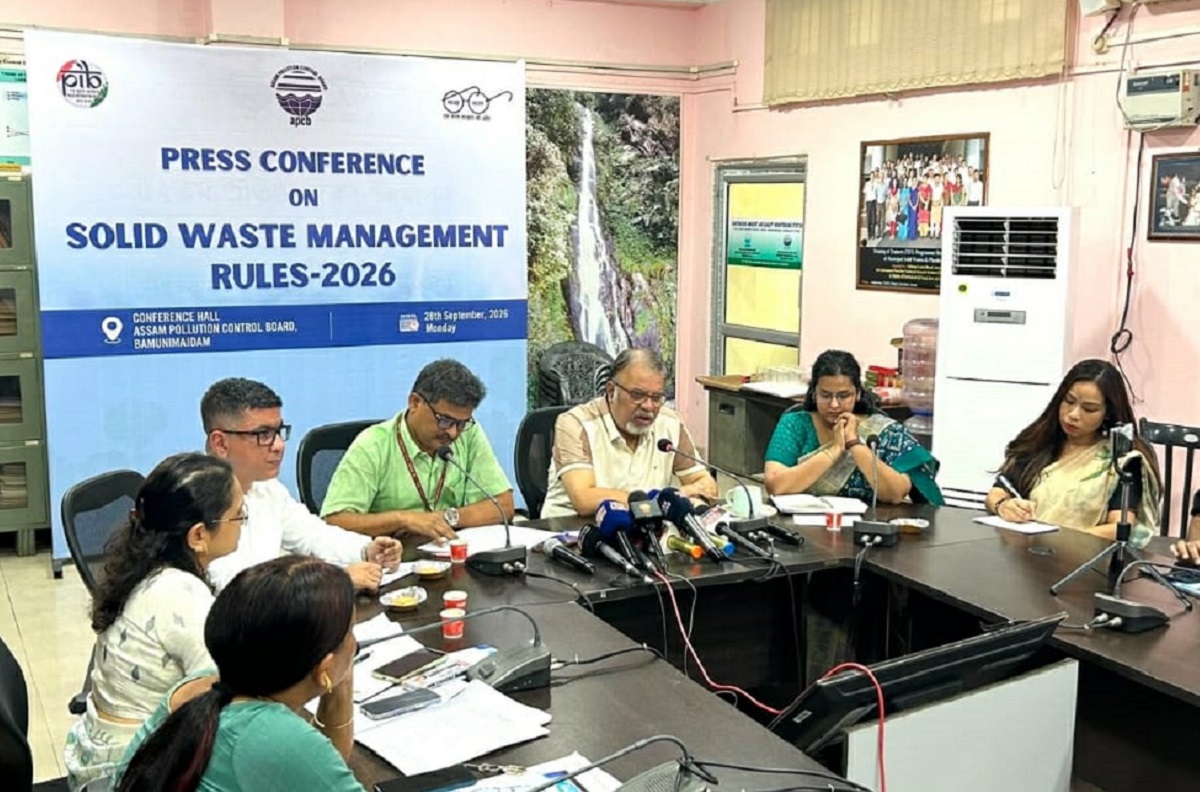
This was revealed at a joint press conference by the Assam Pollution Control Board, Swachh Bharat Mission (Urban) and Swachh Bharat Mission (Gramin), Assam in Guwahati today.
The new strategy was adopted after the Union Ministry of Environment, Forest and Climate Change notified the Solid Waste Management (SWM) Rules, 2026, under the Environment (Protection) Act, 1986 which came into effect from April 1, 2026.
Sabyasachi Kashyap, Mission Director of Swachh Bharat Mission (Urban), detailed the concrete steps taken across Assam’s urban centers and highlighted the promotion of a circular economy based on the principles of reduce, reuse and recycle, alongside the development of Compressed Bio-Gas plants in 5 major cities across Assam through public-private partnerships with Oil India Limited to convert waste into clean energy. Following the Supreme Court’s directives, detailed infrastructure audits are being conducted across all 96 urban local bodies, while Town and Country Planning authorities are integrating mandatory SWM specifications and composite pits into building permissions for new constructions.
Kashyap further reported that 59 urban local bodies have mapped their legacy waste sites, 561 garbage-vulnerable points out of 651 have been transformed and dedicated cleanliness measures have been instituted across 198 identified high-footfall tourist and pilgrimage spots. He added that citizen grievances are being actively resolved through the integrated Swachhtam digital platform.
Complementing the urban strategy, senior officials from Swachh Bharat Mission (Gramin) highlighted the rural implementation framework designed to ensure comprehensive coverage across Assam’s countryside. They outlined the systematic management of rural waste streams, focusing on the decentralization of biodegradable and non-biodegradable waste processing through community compost pits established across villages. To enforce structured governance at the grassroots level, a formal Gaon Panchayat Order will be promulgated in every village on October 2, establishing localized waste management rules. Furthermore, Swachh Bharat Mission (Gramin) is deploying digital tracking systems for waste collection vehicles to ensure transparent and reliable door-to-door collection across rural habitations.
Dr. Arup Kumar Mishra, Chairman of Pollution Control Board Assam, emphasized that waste management is no longer the exclusive mandate of pollution control boards, but a collective operational duty for all local bodies, institutions and citizens.
He explained that while materials like plastics and discarded tires have historically created major environmental menaces, the 2026 framework strictly prioritizes avoiding landfills and treating organic biodegradable waste as a valuable resource.
Elaborating further on the operational mandates, Dr. Mishra highlighted the foundational requirement of four-stream waste segregation at source, requiring every household, establishment and institutional generator to store wet biodegradable waste, dry recyclables, securely wrapped sanitary waste and special care waste—such as CFL bulbs, expired medicines, batteries, tube lights, and syringes—in separate containers before handing them over to authorized collectors.
Assam launches comprehensive multi-agency strategy to implement Solid Waste Management Rules, 2026