
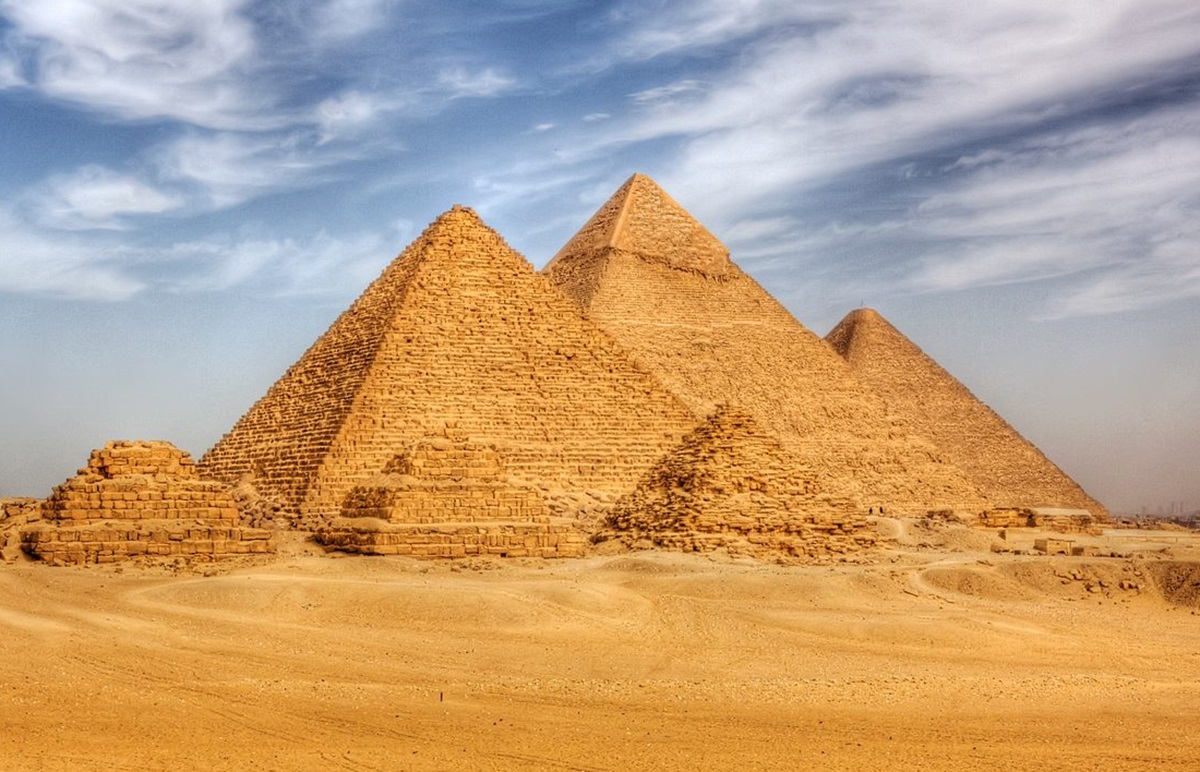
A new interpretation of the Great Pyramid of Giza suggests that its dimensions may contain a hidden mathematical pattern reflecting the movements of the Moon, stars and planets. Independent researcher Sefy Levy has examined the monument’s height, base and sloping sides and argues that their measurements produce numerical relationships that could be connected to ancient Egyptian mathematics and astronomy.
Levy’s claims are presented in a paper published on SSRN, but the research has not been peer-reviewed. The findings have also not been confirmed by mainstream Egyptologists. Using fractions associated with ancient Egyptian mathematical methods, Levy studied measurements of the Great Pyramid and identified several numbers that he says are remarkably close to astronomical cycles and mathematical constants.
One of the calculations produced 27.5, which Levy links to the 27.55-day interval between successive lunar perigees, when the Moon is at its closest distance to Earth. Another calculation produced 70, which he associates with the approximate period during which Sirius was hidden from view by the Sun’s glare.
Levy also argues that other results may correspond with the movements of Jupiter, Saturn, Venus and Mars. In addition, he points to possible relationships involving pi and the golden ratio, two mathematical constants that have frequently featured in theories about the design of ancient structures.
To investigate whether similar patterns could emerge randomly, Levy reportedly compared his calculations with 100,000 computer-generated pyramid designs. Around 2.4 per cent of the models showed similar patterns, which he says could indicate that the dimensions of the Great Pyramid were intentionally chosen.
However, the findings cannot by themselves establish that the ancient Egyptians designed the Great Pyramid as a mathematical or astronomical code. Built around 4,500 years ago during the reign of Pharaoh Khufu, the Great Pyramid is traditionally considered part of the pharaoh’s funerary complex.
As reported by The Metro, Levy has proposed that the monument may have had a broader purpose, potentially serving as a permanent record of ancient knowledge. He has also suggested that its design could have been connected with Benben, the primordial mound described in ancient Egyptian creation mythology.
The proposed connections remain speculative, and there is currently no independent evidence proving that the Great Pyramid was deliberately built to encode information about lunar, stellar or planetary cycles. Even so, the theory adds to the long-standing debate about how and why one of the ancient world’s most remarkable monuments was designed.