
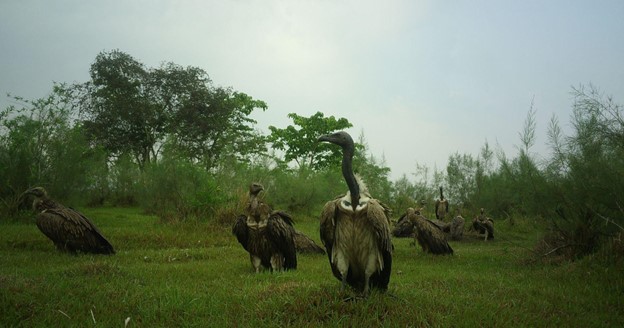
In a promising development for Assam’s wildlife conservation efforts, a joint biodiversity assessment carried out by Balipara Foundation, in collaboration with the Mising community of Dhapak village in Majuli Island, has revealed a potential island habitat for critically endangered and threatened vulture species. The initiative forms part of an assisted natural regeneration project under CSR support, aiming at ecological restoration of the island ecosystem.
Conducted in March 2026, the survey enlisted active participation from local youth, who were trained by Dr. Subham Chandra Mondal, senior environment specialist at Balipara Foundation in basic wildlife survey techniques such as camera trapping and line transect methods.
Covering around 200 hectares of grassland-woodland habitat, the team documented 55 bird species, 5 mammals, and 20 butterfly species, highlighting the island’s rich biodiversity.
Among the avian records, two sightings stood out for their conservation value — 10 Slender-billed Vultures (Gyps tenuirostris), classified as Critically Endangered by the IUCN, and 60 Himalayan Griffons (Gyps himalayensis), a Near Threatened species.
The population of Slender-billed Vultures in India is estimated at around 1,000 individuals (BirdLife International, 2021).
A recent report by the Wildlife Institute of India (WII, 2025) further highlights that only about 40 breeding individuals of this species remain in Assam. The same WII (2025) report estimates the population of Himalayan Griffon in India at approximately 890 individuals, underscoring the conservation importance of these observations.
The survey also recorded the Swamp Francolin (Ortygornis gularis) and Oriental Darter (Anhinga melanogaster), both listed as Near Threatened. Slender-billed Vulture, Himalayan Griffon and Swamp Francolin are protected under Schedule I species of the Wildlife (Protection) Act, 1972.
“Finding such significant numbers of vultures is crucial,” said Dr. Pulakeswar Basumatary, wildlife researcher and part of the assessment team, who previously reported the rare winter migratory bird Naumann’s Thrush from Assam. “The population of Slender-billed Vultures has seen a drastic decline in recent decades, and their presence here underscores the ecological importance of Majuli’s habitats.”
The village head, Nahorjyoti Satula, remarked that the vulture sightings are closely linked to the community’s traditional cattle rearing practices, where cattle carcasses serve as a key food source. He emphasized the need to promote awareness and tree plantation along village edges to aid roosting and nesting opportunities for the birds.
Dr. Bidyut Sarania, Lead (Research and Development) at Balipara Foundation, noted that biodiversity surveys of such riverine ecosystems offer insights into habitats supporting not just avifauna but also endangered mammals like the Asian Elephant (Elephas maximus) and Bengal Tiger (Panthera tigris). “Our aim is to create a network of community youth for long-term conservation through ecological restoration,” he said, adding that a systematic nest survey of vultures will soon be undertaken across island and riverine habitats along the Brahmaputra.
Home to diverse ecosystems, Majuli is already recognised as a Biodiversity Heritage Site, a Key Biodiversity Area (KBA), and an Important Bird and Biodiversity Area (IBA). This recent survey reinforces its standing as one of Assam’s most vital natural landscapes — a fortress for vulture recovery and broader ecological resilience in the Brahmaputra basin.