
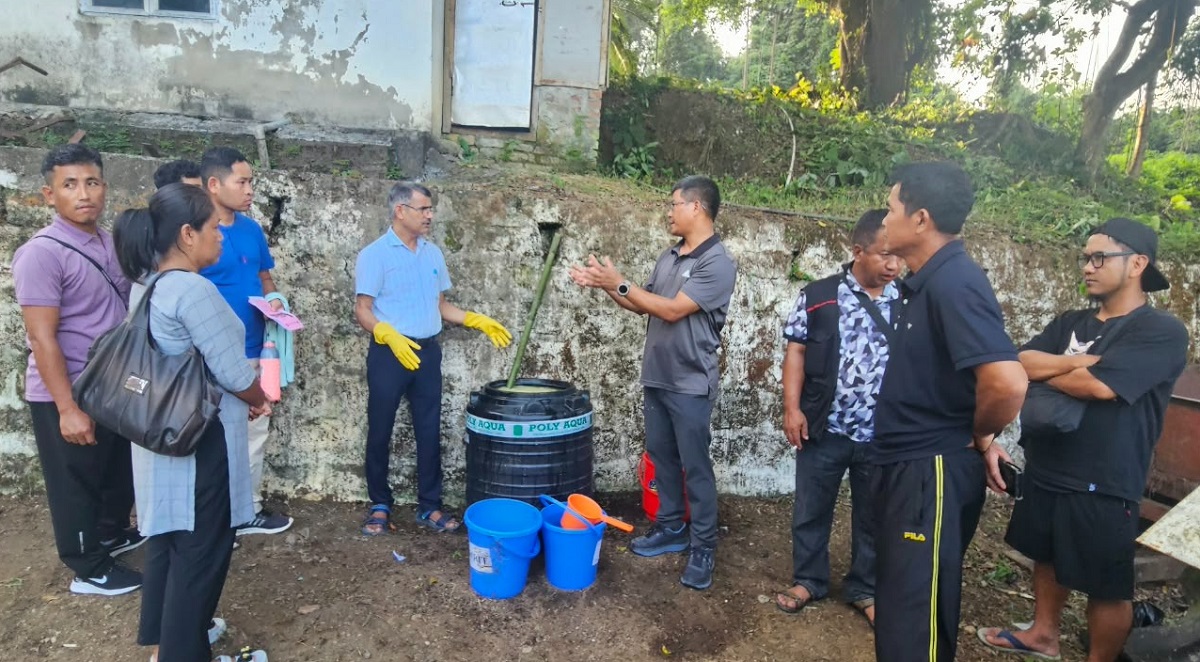
In a bid to strengthen community knowledge and promote environmentally sustainable agricultural practices, biodiversity organisation Aaranyak, in collaboration with Krishi Vigyan Kendra (KVK), Mamit district, organised a two-day residential training programme on Integrated Farming Systems at KVK, Lengpui, Mizoram, on November 3 and 4.
Supported by IUCN-KfW, the programme brought together 12 participants, including seven men and five women, from six project villages — Rajiv Nagar, Tuipuibari, Damparengpui, Teirei, Saithah and Lallen. The training was designed to improve participants’ understanding of Natural Farming and Integrated Farming Systems through technical sessions, practical demonstrations and field visits.
The inaugural session began with a welcome address by Dr Vanlalhruaia Hnamte, Senior Scientist and Head of KVK, Mamit. Dr M. Chinlampianga, Project Director of the Agricultural Technology Management Agency (ATMA), Mamit, spoke on the functions and responsibilities of Community Resource Persons (CRPs). An interactive ice-breaking session was conducted by Mrs Vanlalruali, Course Coordinator at KVK Mamit, to encourage participation and interaction.
Experts from different agricultural disciplines conducted technical sessions covering agroforestry, animal science, horticulture, plant protection, agricultural extension and agronomy. The sessions were led by subject matter specialists Dr Rebecca Lalmuanpuii, Dr C. Rinawma, Dr Vanlalhmuaka Ngente, Dr Vanlalhruaia, Mrs Vanlalruali and Dr Om Parkash.
On the second day, participants learned about the importance of mulching in Natural Farming, the judicious application of fertilisers and pesticides, and the differences between Natural Farming and Organic Farming. Practical sessions and field demonstrations on vermicomposting, natural farming techniques and the preparation and application of Beejamrit, a traditional microbial seed treatment, were also organised.
The programme provided participants with practical knowledge of integrating different farming components, making efficient use of available resources and adopting environmentally responsible agricultural methods. It also aimed to equip them with techniques that could be replicated in their respective villages to enhance agricultural productivity and ensure long-term environmental sustainability.
The training programme was conducted under the guidance of Dr M. Firoz Ahmed, Director and Head of Aaranyak’s Tiger Research and Conservation Division (TRCD); Dr Dipankar Lahkar, Assistant Director, TRCD; and C. Vanlalrema, Liaison Officer, Aaranyak.


