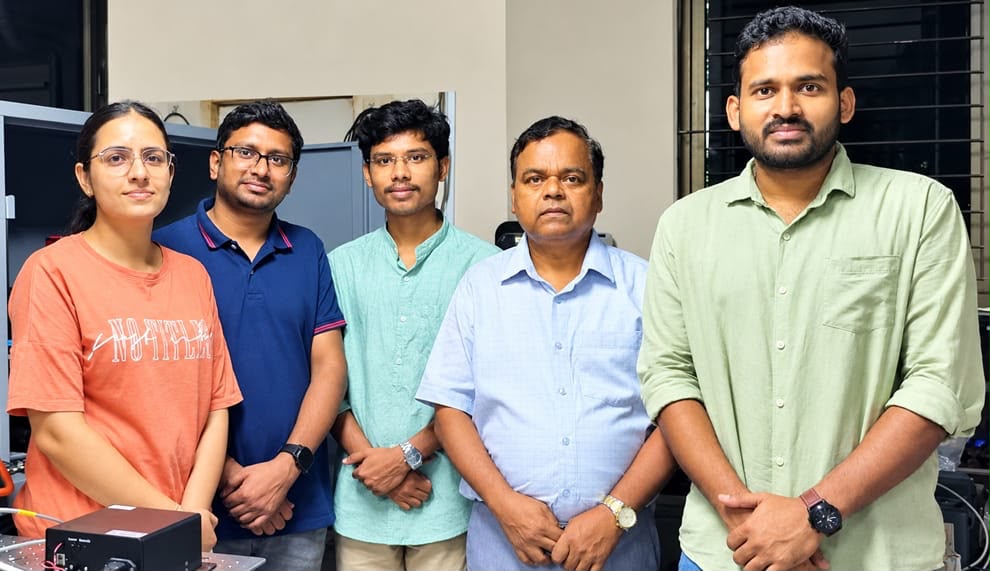
Researchers at the Indian Institute of Technology Guwahati (IIT Guwahati), in collaboration with IIT Kharagpur, have developed a light-sensitive device inspired by the human brain that can detect, store and process visual information while using very little energy.
The technology could be useful in facial recognition, robotic vision, artificial intelligence and other smart computing applications. According to the researchers, the device consumes 500 times less energy than conventional MXene-based devices in laboratory tests.
In conventional electronic systems, cameras capture images, memory devices store information, and processors analyse the data. These separate operations require the transfer of large amounts of data and consume considerable energy.
The human brain, however, can recognise objects, remember information and learn from experience while using much less energy. Inspired by this ability, the researchers have developed an artificial synapse, a device that works in a way similar to the connections between nerve cells in the brain.
Explaining the difference, Professor P. K. Giri, lead author of the research and a professor in the Department of Physics at IIT Guwahati, said that an electronic camera captures an image of an apple and sends the digital data to a processor for analysis. The human brain, on the other hand, can recognise an apple quickly by using previously stored information about its colour, shape and surroundings.
The research team developed an ultrathin, light-sensitive artificial synapse using MXene nanosheets, an electrically conductive two-dimensional material, and an organic semiconductor called P3HT.
When light falls on the device, electrical charges form and separate at the junction of the two materials. These charges remain separated for a long time, allowing the device to retain information even after the light is switched off.
The device can also respond more strongly to repeated light signals. In experiments, the response to the second light signal was 180 per cent stronger than the response to the first. This behaviour resembles the way connections between brain cells become stronger through repeated stimulation and learning.
The researchers tested the device in facial recognition and traffic-scene segmentation, a process used to identify different objects and areas in road images. It achieved 90 per cent accuracy in facial recognition and 85 per cent accuracy in traffic-scene segmentation.
The device was developed using a low-cost solution-processing technique, which could help make the technology more affordable for future applications.
The findings have been published in the scientific journal Carbon. The research team included Sanjoy Sur Roy, Dr Sanju Nandi, Debabrata Sahu, Garima Choudhary and Professor P. K. Giri from IIT Guwahati, along with Professor M. Meyyappan, Saswata Goswami and Professor Chandra Sekhar Tiwary from IIT Kharagpur.