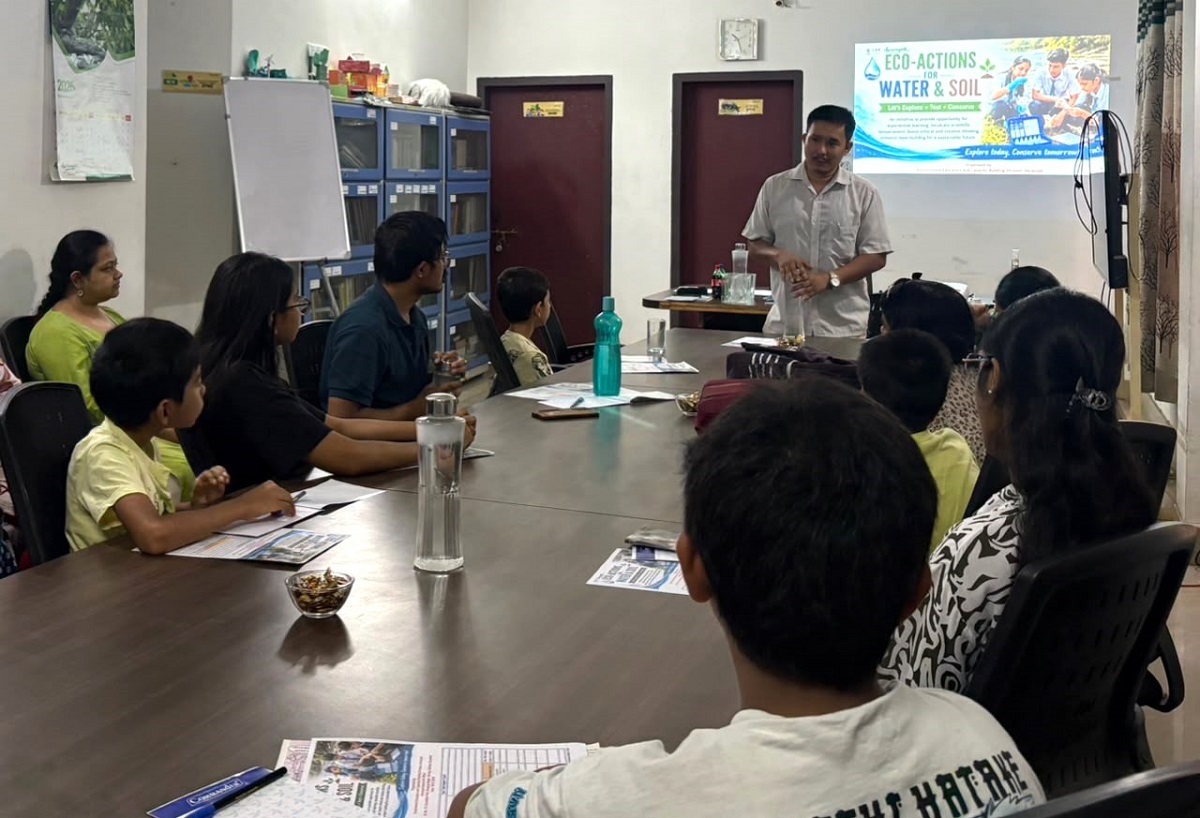
Promoting responsible water use and sustainable household practices, leading biodiversity conservation organisation Aaranyak organised an interactive workshop titled “Eco-actions for Water and Soil” at its research office on July 19, bringing together parents and children from different districts of Assam to learn practical techniques for water quality testing, household water auditing and water conservation.
The workshop, organised by Aaranyak’s Environment Education and Capacity Building Division (EECBD), aimed to build public awareness on the importance of conserving freshwater resources and empowering families with simple scientific tools to assess the quality and quantity of water they use every day.
Opening the programme, Jayanta Kumar Pathak, Assistant Director of Aaranyak’s EECBD, underlined the growing global concern over water scarcity, pollution and unsustainable consumption. He stressed that while households routinely monitor their financial expenditure, very few keep track of their daily water use.
“Most families monitor their spending on groceries and other essentials but rarely measure or think about their water consumption, while water is much more crucial than the others. If we don’t know that, how will we plan for water management at the household level?” Pathak said.
He urged participants to adopt responsible water-use practices, understand the quality of the water they consume and develop the habit of conducting regular household water audits as an effective step towards water security.
The workshop combined expert-led discussions with practical demonstrations, enabling participants to gain hands-on experience in assessing both water quality and household consumption patterns.
Participants brought water samples from their homes and used portable water testing kits to analyse key drinking water parameters, including pH, Total Dissolved Solids (TDS), iron, hardness and fluoride. The exercise helped participants understand how these indicators influence water quality and whether the water is safe for drinking.
The workshop also introduced participants to the concept of a household water audit, where families estimated the quantity of water used daily for drinking, cooking, bathing, washing and other domestic purposes. Each participant received a water audit format to record and monitor household water consumption over time, encouraging evidence-based water conservation and behavioural change.
The technical sessions and practical demonstrations were conducted by Tikendrajit Gogoi, Geetashree Sarma and Ashatora Sarma of Aaranyak’s Environment Education and Capacity Building Division (EECBD). Through interactive learning, participants developed a better understanding of water quality monitoring, efficient water management and sustainable practices that can be incorporated into everyday life.
The programme concluded with a certificate distribution ceremony followed by an interactive discussion, during which participants reflected on their learning experiences and pledged to adopt more sustainable water-use practices within their households and communities.
With freshwater resources facing increasing pressure from climate change, pollution and rising demand, initiatives such as Eco-actions for Water and Soil seek to strengthen community capacity and encourage informed, science-based action towards achieving long-term water security and environmental sustainability.